Could your team rebuild it without AI?
Your team's work has never looked better.
Your team’s work has never looked better.
The analysis that used to take three weeks drops in an afternoon. The decks look slick. The answers come back polished, confident and complete.
So try something on the next one that crosses your desk. Ask the person who handed it to you to walk you through how they got there. Not what it says. Why it’s right.
More and more often, the honest answer is they can’t. Not confidently, anyway.
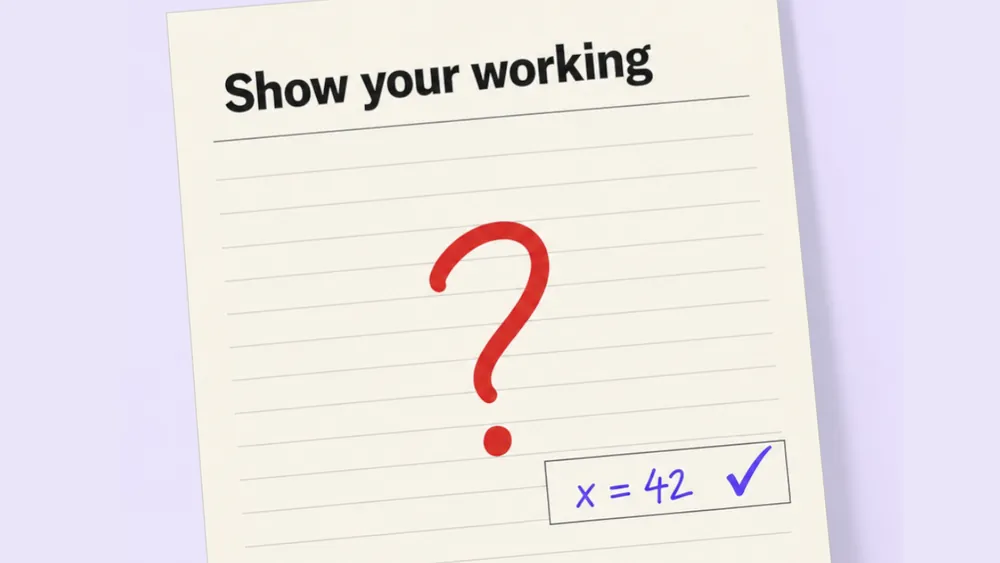
I was the kid at school who never showed his working. I could see the answer, so writing out the steps felt like busywork. Took me twenty years to realise my teachers were right. The working was never about the answer. It was proof I understood the path I took, and that I could walk it again.
AI is that same trap, on steroids.
It hands you a beautifully polished answer in seconds, and nobody did the working. That matters more than it feels like it should, because the answer is a snapshot. The path is the asset.
Think about what you actually keep when a piece of work is done. The answer, sure. But the more valuable thing is that your people now understand something they didn’t before. That understanding compounds onto the next problem, and the one after that. If AI did the working and your team collected the answer, you got the snapshot and lost the compounding.
You feel productive, and you’re getting weaker.
And nothing feels wrong while it’s happening, because the outputs keep coming. The judgment muscle wastes away behind the best-looking deliverables you’ve ever shipped.
I argued this out for a full episode of Never Outdated with a co-host you wouldn’t expect (more on that at the bottom). Here are the key points.
1. Sort the work before you set any rules.
There are two kinds of work in your organisation, and this discipline only applies to one of them.
Tasks. The answer is the only thing that matters and you can check it easily. Meeting summaries, first drafts, formatting, research legwork. Hand these to AI without a second thought. Making people show working here becomes the busywork.
Value creation. The how carries the value. The judgment, the trade-offs you weighed, the options you chose not to take. Strategy, pricing, risk calls, anything a board or regulator might ask you to defend. The working stays human here, because the working is the product.
Most work sits in the first bucket. That’s the freedom in this. Decide where the how matters, and you can let AI loose everywhere else with a clear conscience. Most organisations haven’t had that conversation yet, and any AI rule written without it is guesswork. Have it this month. One page, two columns.
2. Run the rebuild test before you trust the answer.
For the second bucket, one question does most of the work. Could the person who handed me this rebuild it without the tool? Could the team?
If the answer is no, and the decision matters, what you’ve got is dependency dressed up as capability. Treat it that way. Slow that one down. Make the thinking visible. Have someone own the reasoning, not just the result.
The reason the test is worthwhile: AI is a pattern completion machine. Its answer will be correct, given what it was trained on and what you asked. But doing the correct thing and doing the right thing are different, and right depends on context the model doesn’t have. Your customers. Your values. The thing that isn’t in the data. The only person who catches the gap between correct and right is one who did enough of the working to spot it.
One warning. The higher the stakes, the more tempting it is to just take the answer, because high stakes come with time pressure, and pressure makes the shortcut feel like good judgment. The exact moments where the working matters most are the moments you’re most likely to skip it.
3. Ask people to defend the work, not present it.
The tell that capability is hollowing out is simple. Someone can show you the answer but can’t walk you through why.
In an enterprise, that moment comes around a lot. A board asks how you reached a number. A regulator wants the reasoning behind a decision that affected a customer. Risk wants the assumptions. If all you’ve got is a polished output nobody can reconstruct, you don’t really have an answer. You have a liability with good formatting.
Think of a strategy team whose analysis used to take weeks. They pull together the first draft in a couple of hours, and it’s genuinely good. The speed is wonderful. The danger shows up six months later, when nobody can say what the model assumed, what it weighted, what it left out, and they’re presenting numbers they didn’t reason their way to. I’ve seen versions of that more times than I’d like.
Build the defence into your rhythm. When second-bucket work reaches you, ask for the reasoning before the recommendation. What did we assume? What did we rule out? Who owns this number? People start doing the working again when they know they’ll be asked.
The part I put most stock into.
People build judgment by doing the working. By getting it wrong. By sitting in the hard bit and coming out the other side. If AI does all the hard bits, your best people stop developing, and your next generation of leaders never really gets made.
Outsource the task, never the thinking. The entire discipline in six words.
And if you only take one move from this, take this one. Pick your most important decision of the next month, the one with real money or real consequences riding on it. Before anyone touches a tool, ask: when this is done, will my team understand how we got here well enough to do it again without the AI?
If the answer is no, you haven’t sped anything up. You’ve mortgaged your own capability for a faster slide deck.
Where this came from
This article began as the latest episode of Never Outdated, co-hosted by Veda, my AI executive assistant. People keep asking to meet her, so I put her on the show. And yes, I see the irony. An article about not handing your thinking to AI, born from an episode co-hosted by the AI I work alongside every single day. That tension is sort of the whole point.
It’s the first of a new series I’m trialling called AI Duets, just me and Veda in conversation, running alongside the regular guest episodes.
Listen on Spotify: https://open.spotify.com/episode/6nv2lyVJPzP2oVQYUFJRCc Or Apple Podcasts: https://podcasts.apple.com/au/podcast/never-outdated/id1799636085?i=1000774805455
One more thing...
You can only do this if you can see where AI is actually doing the thinking inside your business today. Most leadership teams can't. That visibility is exactly what the AI Opportunity Audit is built to give you.