Why AI Urgency Rarely Comes With Direction
Something feels off for many senior leaders right now.
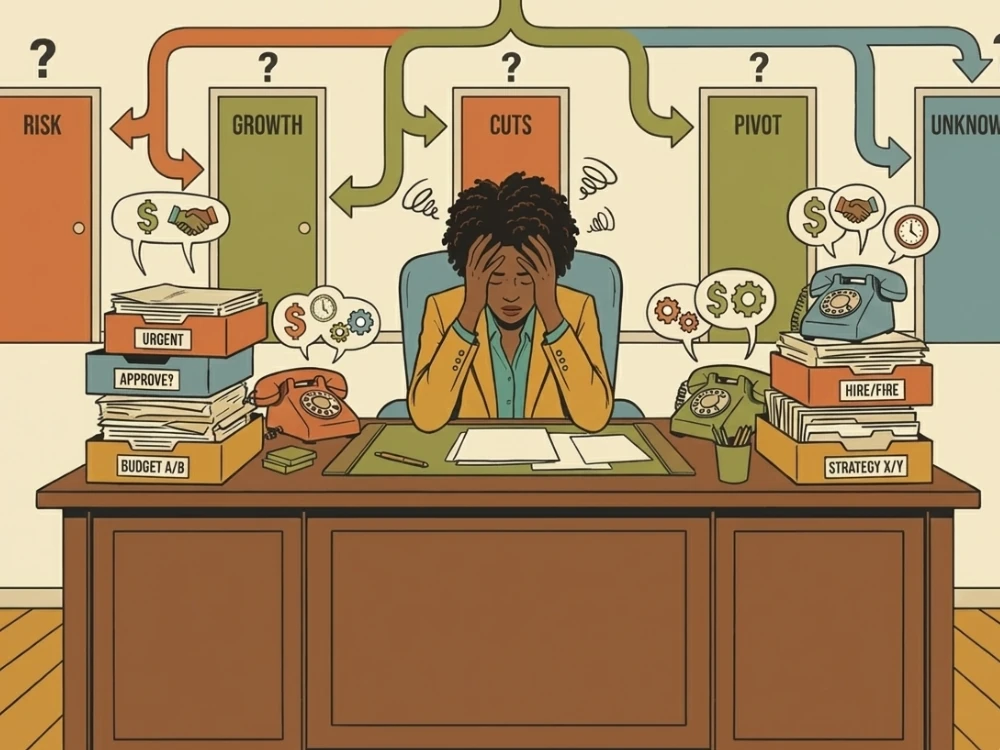
Something feels off for many senior leaders right now.
AI is everywhere in conversation, yet nowhere feels settled. It appears on board agendas as an expectation rather than a choice. It shows up in strategy decks as an assumption rather than a commitment. Leaders sense that progress should already be visible, even when there has been no obvious misstep.
The discomfort is subtle but persistent. It is not panic. It is a quiet awareness that time is passing, competitors are moving, and the organisation is expected to respond. There is pressure to act, but no shared certainty about what action would actually mean.
What makes this unsettling is that nothing is obviously broken. Revenue may be holding. Customers are not revolting. Systems still run. And yet the sense of being exposed grows. Leaders feel accountable for a future that is arriving faster than their ability to frame it.
Mistaking the Source of the Pressure
This unease is often explained away as a technology problem.
AI is said to be moving too quickly. The tools are evolving faster than governance can keep up. Leaders are told they simply need to understand it better. More briefings, more pilots, more literacy.
This diagnosis is attractive because it offers a familiar response. Learn faster. Experiment more. Stay informed. It implies that the pressure will ease once knowledge catches up with change.
But this explanation does not align with what is actually happening inside organisations. Many of the most pressured environments are also the most informed. Leaders who understand the technology still hesitate.
Teams that have run multiple pilots still lack confidence about what matters.
The pressure persists because its cause has been misidentified.
AI Is Revealing Decision Weakness, Not Creating It
What is happening under pressure is simpler and harder to face.
AI is not creating urgency through speed. It is exposing a lack of decision clarity that was already present. It forces questions that organisations have historically avoided or deferred. Questions about priority, ownership, trade-offs, and risk tolerance.
When those questions do not have clear answers, urgency fills the gap. Activity increases because movement feels safer than stillness. The organisation does things to prove it is responding, even when it is not deciding.
AI acts as a spotlight. It illuminates where prioritisation is vague, where decision rights are blurred, and where leaders have relied on consensus rather than choice.
The discomfort is not about falling behind technologically. It is about realising that the organisation does not yet know what it is optimising for.
When Action Replaces Choice, Alignment Starts to Fray
Decisions made from the wrong frame rarely fail loudly at first. They fail quietly.
Resources get diluted across too many initiatives.
Teams work hard on efforts that make sense in isolation but not together.
Governance becomes reactive, stepping in after momentum has already been spent.
Leaders approve activity without conviction. They hedge approvals with caveats. They ask for optionality where commitment is required.
This slows execution understanding, even as visible effort increases. The organisation becomes busy without becoming decisive. Progress feels fragile.
Momentum stalls not because people are resistant, but because alignment has never been properly established.
How This Tension Actually Plays Out Inside Organisations
In practice, this looks familiar.
Strategy sessions end with long lists of AI opportunities and no clear sense of which ones truly matter now.
Steering committees debate tooling choices while the underlying business intent remains unresolved. Initiatives drift between functions because no one has been explicitly empowered to resolve competing priorities.
Teams sense the ambiguity. They keep refining proposals rather than delivering outcomes. Leaders ask for speed, then introduce additional reviews to manage their own uncertainty. Everyone is acting responsibly, yet no one feels confident that the organisation is moving in the right direction.
This pattern is not confined to struggling businesses. It appears most often in capable organisations under real pressure.
What Experienced Leaders Often Underestimate
Capable leaders tend to underestimate how much clarity only they can provide.
In more stable environments, ambiguity could be absorbed through experience and informal alignment.
Today, that buffer is thinner. AI cuts across boundaries too quickly. It surfaces tensions between efficiency and control, innovation and risk, short-term delivery and long-term capability.
Leaders often believe that intent alone is sufficient. That empowered teams will resolve ambiguity through action. Sometimes they do. Often they cannot, because the trade-offs are not theirs to make.
When leaders do not make those trade-offs explicit, teams fill the void. They optimise locally. Leaders then react to the outputs rather than shaping the direction.
The result is frustration on both sides.
The Slow Erosion of Confidence That Follows
If this dynamic persists, the cost appears later.
Months down the line, trust in decision-making weakens. Not trust in individuals, but trust in the organisation’s ability to choose and stick.
People become cautious.
They wait for clearer signals. Initiatives take longer to scale because everyone has learned that direction may change.
Urgency turns into fatigue.
The organisation has been busy for a long time and still feels exposed. At that point, even well-intentioned acceleration efforts struggle to gain traction.
What Changes When Decisions Regain Their Centre
When clarity is restored, the shift is noticeable.
Decisions feel heavier at first, then cleaner. Fewer initiatives move forward, but those that do receive real commitment. Trade-offs are acknowledged rather than smoothed over. Conversations become shorter and more focused.
AI stops feeling like an obligation to chase and starts behaving like a context in which better decisions are made. The pressure remains, but it becomes constructive rather than corrosive.
Urgency does not disappear. It finally has direction.
Join the conversation
If you found value in these insights, you would get even more by joining the conversations yourself. Inside the AI Leadership Academy, leaders are sharing experiences, debating challenges, and building clarity together.